.jpg)
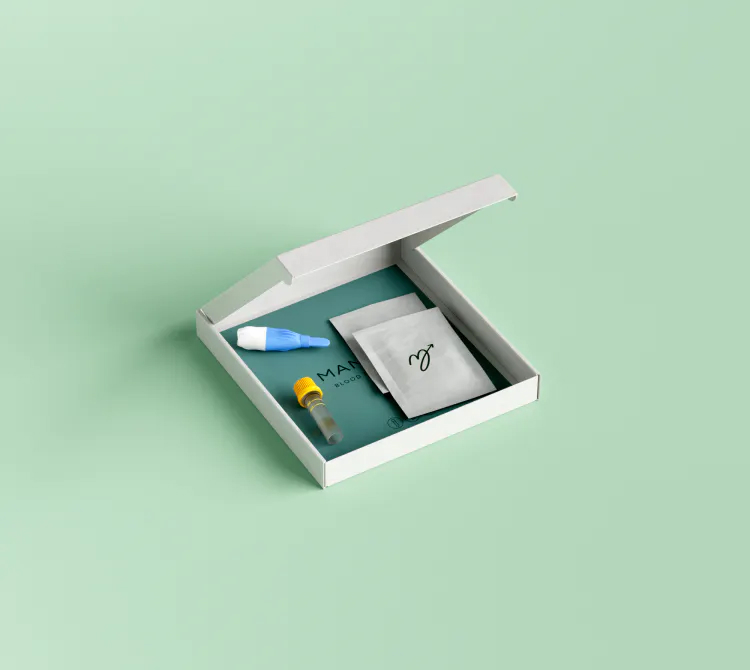
Initial diagnosis test which measures your testosterone levels and checks your eligibility for testosterone replacement therapy.
1 in 4 men over the age of 30 have low testosterone. Our Testosterone Blood Test checks your total and free testosterone levels conveniently at-home.
Testosterone is the hormone that is responsible for most male characteristics
For men, it regulates sex drive and fat distribution, increases bone and muscle mass, improves strength and increases the production of red blood cells and sperm.
It is also really important for a man’s mood, cognition and motivation.
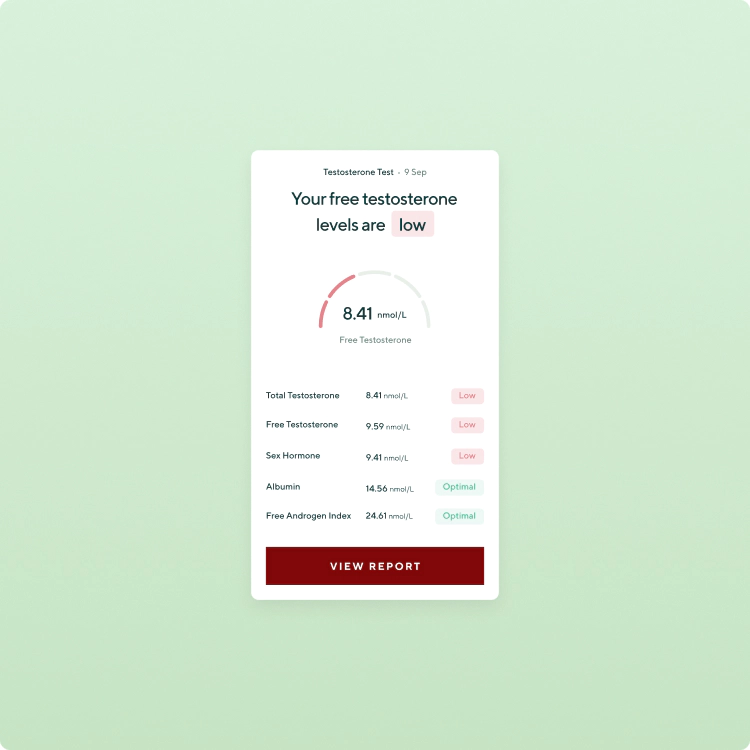
Total testosterone is the amount of testosterone in the blood. However, there are components of the blood that bind to testosterone, namely SHBG and albumin, making it less available for use in the body.
We measure these and provide a free testosterone level which is more important to test than total testosterone alone as this may be low despite a normal testosterone level.
SHBG stands for Sex Hormone Binding Globulin. This is a molecule that binds to testosterone in the blood and helps to transport it around the body.
However, if levels are too high it can reduce the amount of testosterone available to cells in the body, causing low testosterone symptoms.
A protein that binds weakly to testosterone in the blood.
If levels are too high it can reduce the amount of testosterone available to cells in the body, causing low testosterone symptoms.
Free Androgen Index (also known as FAI) is a ratio used to determine free testosterone levels in humans.
It is based on the amount of SHBG in the blood.
If you are looking to understand your testosterone levels to see if you are appropriate for TRT, or just to check your levels, then we have you covered with this blood test.
This test looks at total and free testosterone for the best analysis of your testosterone levels.
Total testosterone is the amount of testosterone in the blood. However, there are components of the blood that bind to testosterone, namely SHBG and albumin, making it less available for use in the body. So we also track these and your free testosterone levels to get a full picture of your testosterone levels.
In line with current BSSM guidelines we require two blood test results, a full blood count (FBC) and a lipid screen to provide TRT treatment.
This test is a first eligbilty test to check your testosterone levels.
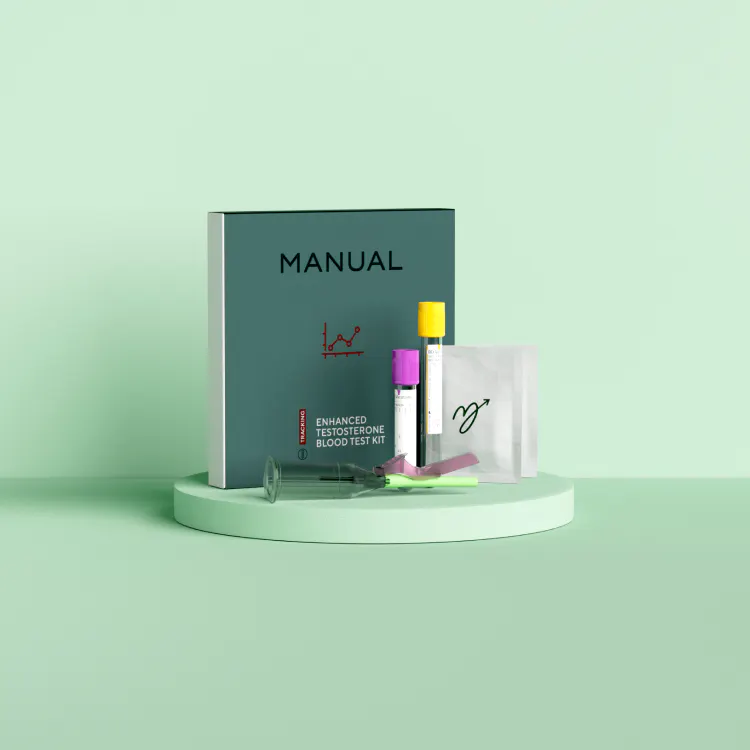
Our Enhanced Testosterone Blood Test provides a full set of tests including full blood count (FBC) and lipids.
We can accept most blood results from other sources, please contact us to check.
We also require documentation of prostate examination results for men over the age of 45 before starting treatment.
If you have never done a testosterone blood test before, or you do not have a recent result measured in the last 6 months, this is the right test for you. It will measure both your total and free testosterone levels to assess your eligbility for treatment.
If you are currently an Manual patient, then please note that this test isn’t suitable for follow up or TRT monitoring blood tests for current patients, unless otherwise indicated or advised by Manual.
We can accept most blood results from other providers, please contact us to check.

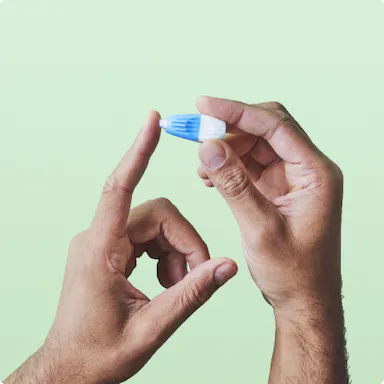
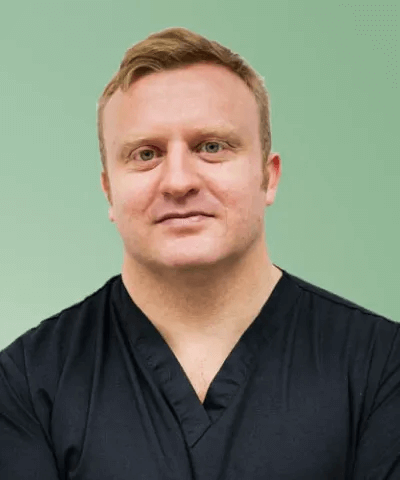
Here’s our Chief Medical Officer, Dr. Earim Chaudry, with a step-by-step video that shows you how to take a blood sample safely and effectively.
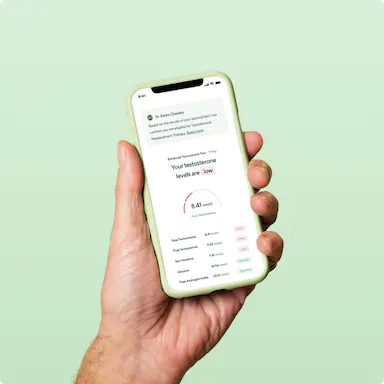
Access meaningful easy-to-understand insights into your testosterone levels and overall health any time from your secure online account.

Our team of TRT specialists provide ongoing advice and treatment by factoring in your unique lifestyle, lab results, symptoms, and medical history.

Continuous monitoring of your testosterone health with quick, easy repeat testing lets us fine-tune your treatment to optimise your results.

We have the UK's leading doctors and experts in testosterone replacement therapy. Meet our team.


Low testosterone is a common condition that men can be born with or develop due to age, stress, disease, physical trauma, an unhealthy lifestyle or environmental factors.
Men with low testosterone often report low mood, irritability, fatigue, anxiety, reduced libido or difficulty achieving an erection. Other common symptoms include brain fog, lack of motivation, low confidence, difficulty losing weight and difficulty gaining muscle.
Blood testing is the only way to know for sure if you have a testosterone deficiency. Our Initial Testosterone Blood Test (a simple finger-prick test) can be taken at home. If the results show that you have low testosterone and you’d like to start testosterone replacement therapy, UK regulations require you to take a second, more comprehensive blood test first to ensure that you can safely start treatment. This one is a venous test which has to be administered by a nurse or phlebotomist.
Research has confirmed that testosterone counts in men are significantly lower than they were just a few decades ago. One in four men over the age of 30 may have abnormally low testosterone levels according to scientific studies.*
Around the age of 30 testosterone levels naturally begin to decline, but it’s usually a very gradual process. For most men, testosterone levels drop between one to two percent each year from the age of 35. Free testosterone levels also drop considerably as men age, making TD even more common. An increase in obesity, hormone-disrupting environmental chemicals, and anabolic steroid use is also making testosterone deficiency in younger men more prevalent than ever.
*The Journal of Clinical Endocrinology & Metabolism
Yes, you’ll have a consultation with one of our doctors to discuss your test results and they can provide a personalised treatment plan tailored to your needs. Our doctors specialise in TRT for men and are all registered with the General Medical Council.
Our initial blood test will establish whether you have a testosterone deficiency. If the first test shows that you have low testosterone you’ll need to take our second, more comprehensive blood test if you’d like to start TRT - this is due to UK regulations. If both tests show that you have low T levels, you’ll discuss suitable treatment options with one of our doctors and during an in-depth consultation before starting treatment.
Our blood test kits usually arrive within three working days. It may take longer over public holidays.
We’ll get in touch to give you your results within two to three business days. One of our TRT specialists will then walk you through the results, provide advice, and answer all of your questions.

A comprehensive venous blood test used to confirm the initial test results, learn more about your health, and assess whether it’s safe to start treatment.
Buy Now